Patient Information
Frequently Asked Questions About Prostate Treatment
Answers to common questions about enlarged prostate,
BPH treatment options, procedures and recovery.
What is the best treatment for an enlarged prostate?
There is no single best treatment for everyone. Depending on
prostate size, anatomy, symptoms, bladder function and medical
history, treatment may include medicines, TURP, HoLEP, Rezum,
UroLift or iTind. A urological evaluation helps determine
which options may be suitable.
What is the difference between TURP and HoLEP?
TURP removes obstructing prostate tissue using an endoscopic
resection instrument. HoLEP uses a holmium laser to separate
and remove obstructing tissue from the prostate. Both aim to
relieve urinary obstruction, but the techniques and surgical
considerations are different.
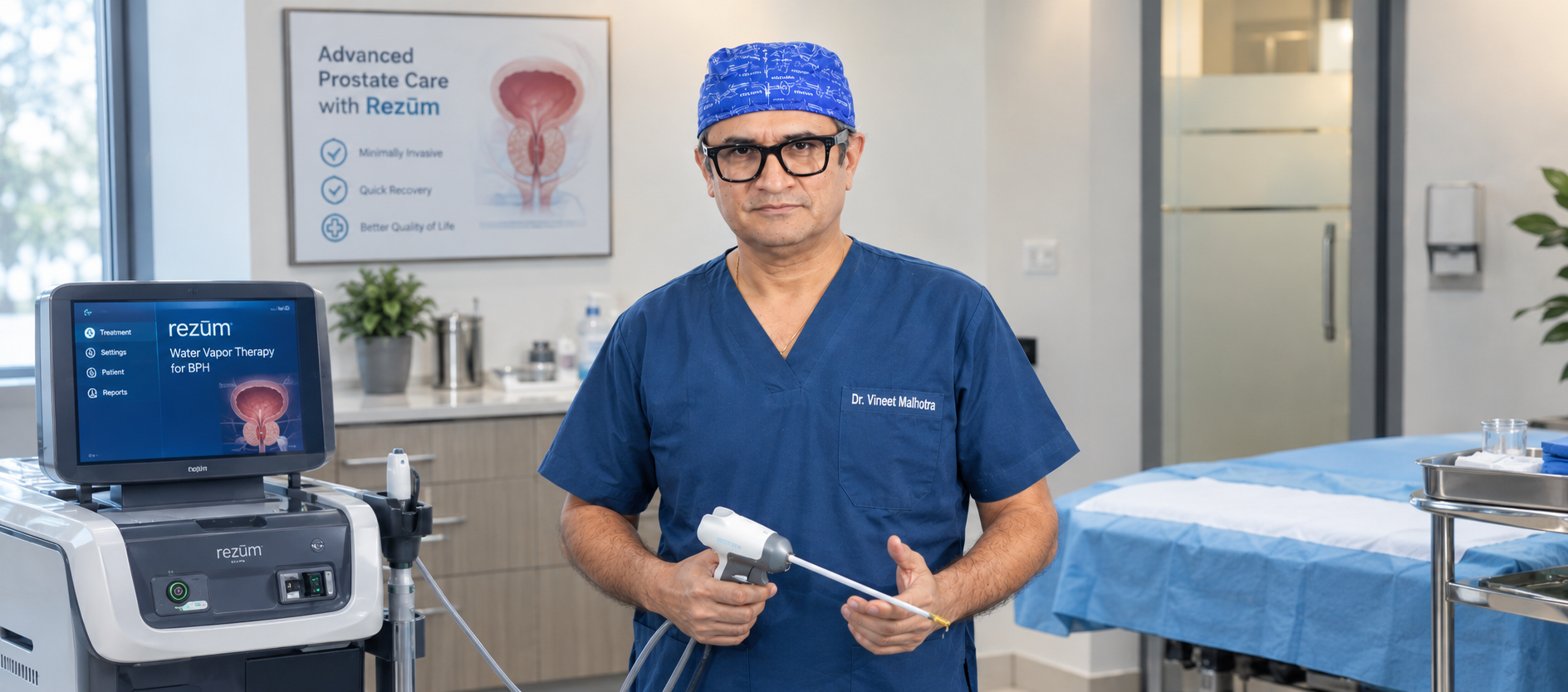
What is Rezum Water Vapour Therapy?
Rezum is a minimally invasive BPH treatment that delivers
controlled water vapour into selected areas of prostate tissue.
The treated tissue gradually reduces through the body's
natural healing process. Improvement is not necessarily
immediate, and temporary urinary symptoms or catheter use
may occur.
What is UroLift treatment for the prostate?
UroLift is a prostatic urethral lift procedure. Small implants
are used to hold selected prostate tissue away from the
urethra, widening the urinary passage. Suitability depends
on prostate size and anatomy.
What is iTind treatment?
iTind uses a temporary implantable nitinol device placed
through the urethra. It applies controlled pressure at
selected points to remodel the prostatic urethra. The device
is removed after the planned treatment period. It is not
appropriate for every patient.
Are Rezum, UroLift and iTind minimally invasive treatments?
Yes. These are minimally invasive approaches that work
differently from tissue-removing operations such as TURP
and HoLEP. Their suitability depends on patient selection,
prostate anatomy, device indications and availability.
Will prostate treatment affect sexual function?
Sexual and ejaculation-related effects differ between
procedures and between individuals. Some treatments can
cause changes in ejaculation, while other sexual effects
may depend on the patient's existing health and condition.
Discuss your priorities and concerns with your urologist
before choosing a procedure.
Does every enlarged prostate require surgery?
No. Many men can initially be managed with monitoring,
lifestyle adjustments or medication. A procedure may be
considered when symptoms remain troublesome despite
treatment, complications develop, or clinical findings
indicate that an intervention is appropriate.
How is prostate size measured?
Prostate size is commonly assessed using ultrasound.
The urologist may also consider prostate shape, urinary
flow, post-void residual urine and other findings when
selecting a treatment.
How long does recovery take after prostate surgery?
Recovery varies according to the procedure, the patient's
health and the nature of the condition. TURP and HoLEP
generally involve a different recovery process from
minimally invasive treatments such as Rezum, UroLift
and iTind. Your treating team will provide procedure-specific
instructions.
Can an enlarged prostate cause urinary retention?
Yes. Significant obstruction can sometimes cause urinary
retention, meaning the bladder cannot empty adequately.
Sudden inability to pass urine is a medical emergency
and requires urgent medical attention.
Can I consult Dr. Vineet Malhotra for prostate treatment in Delhi?
You can request an appointment with Dr. Vineet Malhotra
at VNA Hospital, New Delhi, for evaluation of prostate
enlargement and urinary symptoms. The consultation
helps determine which investigations and treatment
options may be appropriate.