
Penile implant surgery, also known as penile prosthesis surgery, is an established treatment option for selected men with severe or persistent erectile dysfunction (ED). A surgically placed device helps provide penile rigidity when natural erections are not adequate for sexual activity.
Dr. Vineet Malhotra provides evaluation and surgical treatment planning for men considering different types of penile implants, including malleable, semi-rigid and inflatable penile prostheses. Implant selection is individualised after a detailed medical and surgical assessment.
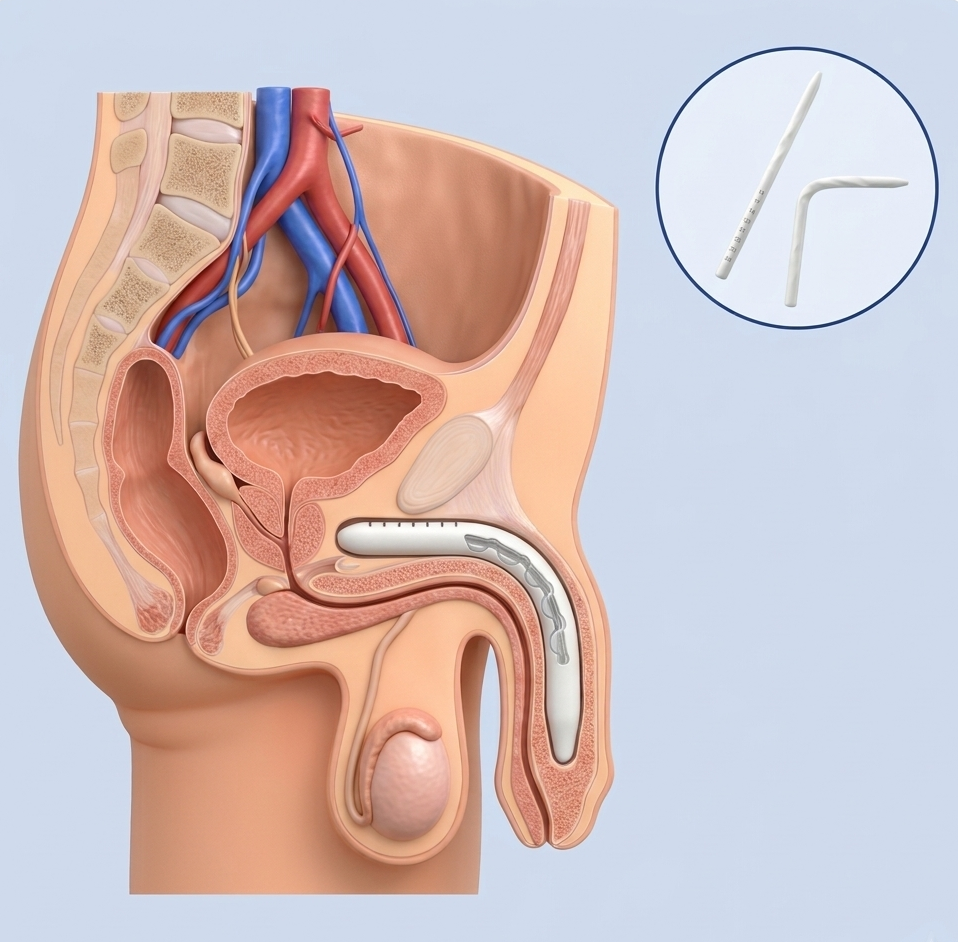
Penile implant surgery is a procedure in which a medical device, called a penile prosthesis, is placed inside the erectile chambers of the penis. It is generally considered for men with persistent erectile dysfunction when other suitable treatments have not worked, are unsuitable or are not preferred.
During a natural erection, blood fills the erectile tissues to create firmness. In some men, damage or dysfunction involving blood vessels, nerves or erectile tissue makes it difficult to achieve or maintain adequate rigidity.
A penile prosthesis provides a mechanical way to create rigidity. The device is positioned internally by a surgeon. Depending on the implant type, the penis may remain supported by flexible rods or become erect when an inflatable system is activated.
Penile implant surgery is a treatment for erection rigidity. It does not directly treat low sexual desire, premature ejaculation or every cause of sexual dysfunction.
Penile prosthesis surgery may be discussed when erectile dysfunction significantly affects quality of life and other appropriate treatments have not provided a satisfactory result.
Men with persistent difficulty achieving or maintaining an erection suitable for sexual activity.
Men with diabetes-related vascular or nerve changes contributing to significant erectile dysfunction.
Men whose erection difficulties are associated with impaired blood flow or other vascular factors.
Selected men with persistent erectile dysfunction following prostate, bladder, pelvic or other relevant surgery.
Selected patients with penile curvature and significant erectile dysfunction may be assessed for prosthesis-based treatment.
Men who have not achieved satisfactory results with suitable medication, devices or other conservative treatments.
Penile prostheses are broadly divided into non-inflatable and inflatable devices. The best option depends on individual anatomy, hand dexterity, medical history, expectations and surgeon assessment.
A malleable penile implant contains flexible rods placed inside the erectile chambers. The penis remains supported by the implant and can be manually positioned upward for sexual activity and downward for concealment.
An inflatable penile prosthesis uses fluid-filled cylinders and a pump mechanism. The patient activates the pump to create an erection and uses a release mechanism to return the device to its deflated state.
A malleable penile prosthesis consists of two bendable rods surgically placed inside the corpora cavernosa, the erectile chambers of the penis.
The rods provide continuous structural support. The patient manually positions the penis upward when an erection is desired and downward when concealment is preferred. There is no pump, fluid reservoir or inflation mechanism.
Malleable implants may be considered for men who prefer a comparatively straightforward device mechanism or who may find a pump-operated system difficult to use.
The Shah Indian Penile Prosthesis is described in published medical literature as a low-cost, malleable or semi-rigid penile prosthesis made using silicone-based implant components for selected men with severe erectile dysfunction.
As with other malleable devices, the general principle is to provide internal support and allow manual positioning rather than using an inflatable pump system. Suitability, device specifications and availability should be confirmed during specialist consultation.
The Shah Indian Penile Prosthesis is a specific device and should not be confused with every other malleable implant model. Published descriptions do not replace the manufacturer's current device documentation or individual surgical assessment.
An inflatable penile implant is a surgically placed medical device that allows a man to create penile rigidity when desired by activating an internal pump.
In an inflatable system, cylinders are positioned inside the erectile chambers. A pump is placed within the scrotum, and a fluid reservoir is included in many systems.
When the pump is activated, fluid moves into the cylinders, creating rigidity. The release mechanism returns fluid from the cylinders to the reservoir, allowing the penis to become less rigid.
The exact design and component placement depend on the model selected and the patient's anatomy.
Inflatable implants are available in different configurations. The surgeon discusses the design, operation and suitability of each option before surgery.
A two-piece system combines the cylinders and a fluid-containing pump/reservoir unit. It does not use a separate abdominal reservoir in the same way as a conventional three-piece design.
A three-piece system uses two cylinders, a separate pump and a fluid reservoir connected by tubing. It is a commonly used inflatable prosthesis configuration.
Both device categories are designed to help provide rigidity. Their operation, internal components and day-to-day use are different.
| Feature | Malleable / Semi-Rigid | Inflatable Penile Implant |
|---|---|---|
| Device design | Two flexible or bendable rods. | Inflatable cylinders with pump-based fluid system. |
| How rigidity is achieved | Continuous support from the rods. | Cylinders are inflated when desired. |
| Positioning | Manually positioned upward or downward. | Inflated and deflated using the pump and release mechanism. |
| Pump | No pump required. | Requires a pump mechanism. |
| Reservoir | No separate fluid reservoir. | Depends on model; a three-piece system has a separate reservoir. |
| Device operation | Mechanically simpler to operate. | Requires learning pump operation and deflation. |
| Possible consideration | Continuous firmness may make concealment more noticeable for some men. | More device components and mechanical parts. |
| Selection | Based on anatomy, preference and medical suitability. | Based on anatomy, dexterity, preference and medical suitability. |
Actual device features differ by manufacturer and model. This comparison is educational and does not indicate that one implant is universally better than another.
There is no single implant type that is best for every patient. Selection requires a discussion of health, anatomy, expectations and the practical aspects of using the device.
Diabetes, vascular disease, previous pelvic surgery, infection risk and other health conditions.
Ability to operate an inflatable pump and manage the device comfortably.
Preference for manual positioning or an on-demand inflatable system.
Penile measurements, erectile tissue condition and relevant anatomical considerations.
Response to medication, vacuum devices, injections or other ED treatment options.
Understanding rigidity, sensation, length expectations, recovery and possible complications.
Penile prosthesis implantation is performed by a trained surgical team using an anaesthesia plan appropriate for the patient and the selected implant.
Medical history, physical examination, relevant investigations and anaesthesia assessment.
Discussion of the device category, model, measurements and individual surgical plan.
The anaesthesia team administers the planned anaesthesia and monitors the patient.
The surgeon accesses the erectile chambers and prepares the space for the selected prosthesis.
The implant is placed and checked for position, function and appropriate sizing.
Postoperative monitoring, wound care instructions and scheduled clinical reviews.
Before penile implant surgery, the medical team reviews the patient's overall health and checks for factors that could affect surgical safety or implant infection risk.
Active urinary or skin infections should be identified and managed before elective implantation. Medicines, allergies and previous surgeries must be discussed.
Recovery varies depending on the implant type, surgical approach, general health and whether any additional procedures are performed. The surgeon's postoperative instructions should always take priority.
Some swelling, bruising, tenderness and discomfort can occur. Pain management, wound care and activity instructions are provided by the treating team.
Keep the surgical area clean and follow the instructions provided for dressing changes, bathing and monitoring the incision.
Patients with inflatable implants receive instructions on pump operation and deflation at the appropriate stage of recovery.
Heavy lifting, strenuous activity and other restrictions may apply during early recovery. Follow the individual surgical plan.
Sexual activity should only resume after the surgeon confirms adequate healing and provides clearance.
Follow-up appointments help assess wound healing, device position, comfort and function.
Penile prosthesis surgery can be an effective option for appropriately selected patients, but it is still a surgical procedure and carries potential risks.
Infection involving the implant or surrounding tissues may require antibiotics and, in some cases, additional surgery or device removal.
Temporary discomfort, bruising and swelling can occur during the postoperative healing period.
Inflatable devices may develop mechanical problems, fluid leakage or component malfunction over time.
In selected cases, the device may erode into surrounding tissue or cause pressure-related injury.
Perceived penile length, glans firmness and appearance may differ from a previous natural erection.
Infection, mechanical failure, erosion or other complications may require revision, replacement or removal of the implant.

Dr. Vineet Malhotra provides specialist consultation for urology, andrology and men's sexual health concerns, including erectile dysfunction and penile prosthesis treatment planning.
His qualifications include M.B.B.S., M.S. and D.N.B. (Urology). Men considering penile implant surgery can discuss their medical history, treatment goals, implant categories and the potential benefits and risks during a confidential consultation.
Common questions about penile prosthesis types, surgery, recovery and results.
Learn more about evaluation and treatment of other male sexual health concerns.
Learn about ED causes, diagnostic evaluation and medical treatment options.
Explore TreatmentUnderstand penile curvature, plaque formation and treatment considerations.
Explore EvaluationExplore assessment of different concerns affecting male sexual health.
Explore EvaluationIf you are experiencing severe or persistent erectile dysfunction and wish to understand penile prosthesis options, consult Dr. Vineet Malhotra. Discuss malleable, semi-rigid and inflatable penile implants, surgical suitability, potential risks and realistic expectations.
Contact the clinic to confirm consultation and surgical assessment details.
Hospital: VNA Hospital
Address: 1, Navjeevan Vihar, Geetanjali Enclave, Malviya Nagar, New Delhi, Delhi – 110017
Phone: +91 98100 85849