
Kidney, Ureter & Bladder Stone Treatment in Delhi
Kidney and urinary stones can cause severe pain, blood in urine, nausea and difficulty passing urine. Dr. Vineet Malhotra provides evaluation and treatment planning for kidney, ureter and bladder stones, with treatment options selected according to stone size, location, symptoms, kidney function and individual health needs.
Depending on the clinical findings, treatment may include observation, medical management, shock-wave treatment where appropriate, or minimally invasive endoscopic and surgical procedures.
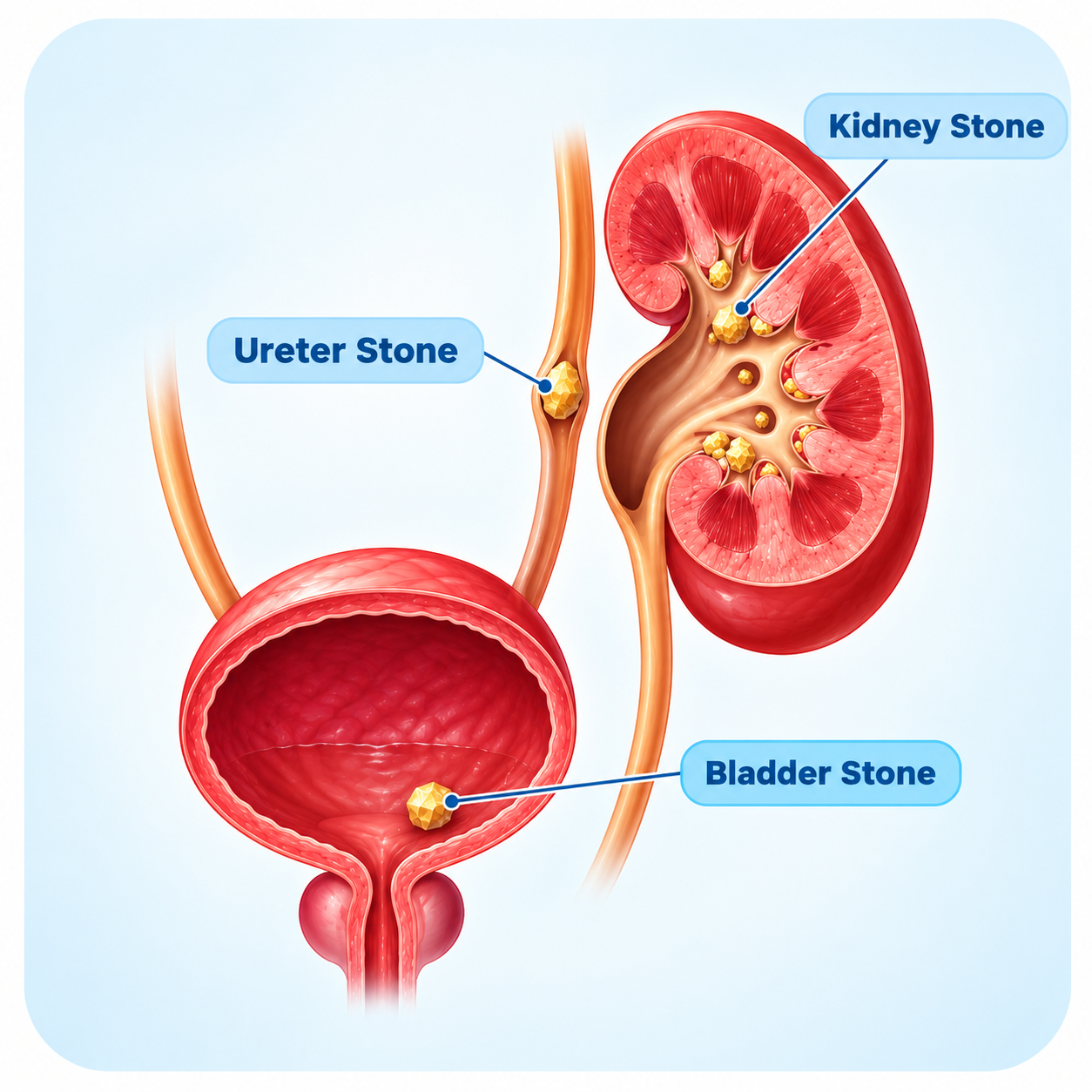
What Are Kidney & Urinary Tract Stones?
Kidney stones are hard deposits formed when minerals and salts in urine crystallise. They may develop in one or both kidneys and can move into the ureter, the narrow tube that carries urine from the kidney to the bladder.
Stones can vary in size and composition. Some remain in the kidney without causing symptoms, while others may obstruct urine flow and cause significant pain. Bladder stones can form when urine does not empty completely or when stones travel down from the upper urinary tract.
The appropriate kidney stone treatment depends on the stone's size, position, composition, degree of obstruction, infection status and the patient's overall health.
Which Areas Can Develop Stones?
- Kidney stones: Develop within one or both kidneys.
- Ureter stones: Become lodged in the tubes connecting the kidneys to the bladder.
- Bladder stones: Form within the urinary bladder, often in association with incomplete emptying.
- Multiple stones: More than one stone may be present in the urinary tract.
Different Types of Kidney & Bladder Stones
Stones are classified by their location and chemical composition. Knowing the stone type can help guide treatment and prevention.
Calcium Stones
Calcium oxalate and calcium phosphate stones are common types of kidney stones. Their formation may be associated with urine chemistry, dietary factors and metabolic conditions.
Uric Acid Stones
These may develop when urine remains persistently acidic. Factors can include metabolic conditions, dietary patterns and inadequate fluid intake.
Struvite Stones
These stones are associated with certain urinary tract infections and may sometimes grow quickly, requiring timely medical assessment.
Common Symptoms of Kidney Stones
Symptoms depend on the stone's location, size and whether it blocks the flow of urine. Some kidney stones cause no symptoms and are discovered during imaging for another reason.
When to seek urgent medical care: Kidney stone symptoms accompanied by fever or chills, inability to pass urine, persistent vomiting, severe uncontrolled pain or reduced urine output require urgent medical assessment. An obstructed infected urinary system can be a medical emergency.
What Causes Kidney Stones?
Kidney stones can develop when certain minerals and salts become concentrated in urine and form crystals. Several factors may contribute to stone formation.
Low Fluid Intake
Not drinking enough fluids can make urine more concentrated, increasing the chance of crystal formation in susceptible people.
Dietary Factors
High sodium intake and certain dietary patterns may increase stone risk depending on the individual's stone type and metabolism.
Family History
A family history of kidney stones may increase an individual's likelihood of developing stones.
Metabolic Conditions
Some metabolic disorders, including conditions affecting calcium, uric acid or oxalate levels, can contribute to stone formation.
Urinary Tract Infections
Certain recurrent urinary infections can contribute to the formation of infection-related stones.
Incomplete Bladder Emptying
Difficulty emptying the bladder, sometimes related to prostate enlargement or other urinary problems, can contribute to bladder stones.
How Are Kidney & Urinary Stones Diagnosed?
Diagnosis helps identify the stone's size, location, number and possible obstruction. The investigations selected depend on the patient's symptoms and clinical assessment.
Medical History & Physical Examination
The doctor reviews symptoms, previous stone episodes, medical history, medicines and relevant risk factors.
Ultrasound Examination
Ultrasound can help identify many kidney stones, bladder stones and signs of urinary tract dilation.
CT Scan
A non-contrast CT scan may be recommended to assess stone size, location and obstruction when clinically appropriate.
Urine Tests
Urine examination may help detect blood, infection and other findings relevant to stone evaluation.
Blood Tests
Blood tests may assess kidney function, infection markers and selected metabolic factors.
Stone Analysis & Metabolic Evaluation
Recovered stones may be analysed. Selected patients with recurrent or high-risk stones may need additional metabolic evaluation.
Advanced Treatment Options for Kidney Stones
Not every kidney stone requires surgery. Some stones can be monitored or managed medically, while others may need a procedure to remove or break them. The decision depends on clinical findings.
Medical Management & Observation
Small stones may sometimes pass naturally. Depending on the stone and the patient's condition, a doctor may recommend observation, adequate fluids where appropriate, pain management and selected medicines to support stone passage.
- Suitable only for appropriately selected patients.
- Follow-up imaging may be needed.
- Obstruction, infection and kidney function must be considered.
ESWL – Extracorporeal Shock Wave Lithotripsy
ESWL uses externally generated shock waves to break selected stones into smaller fragments that may pass through the urinary tract.
- Does not require an endoscope to reach the stone.
- Suitability depends on stone size, location, density and anatomy.
- More than one session may sometimes be required.
URS – Ureteroscopy
Ureteroscopy involves passing a thin endoscope through the natural urinary passage into the ureter to visualise and treat a stone. Laser energy may be used to fragment the stone when appropriate.
- Commonly used for ureteric stones.
- Stone fragments may be removed using specialised instruments.
- A temporary ureteric stent may be required in selected cases.
RIRS – Retrograde Intrarenal Surgery
RIRS is an endoscopic procedure in which a flexible ureteroscope is passed through the urinary tract into the kidney. Laser energy can be used to break stones into smaller fragments.
- Accesses selected stones within the kidney.
- Does not require an external incision to reach the kidney.
- Stone size, number and anatomy influence suitability.
PCNL – Percutaneous Nephrolithotomy
PCNL is a minimally invasive surgical procedure used for selected larger or complex kidney stones. A small access tract is created through the skin into the kidney to remove or fragment stones.
- Often considered for large or complex renal stones.
- Stone fragments are removed through the access tract.
- Hospital stay and recovery depend on individual circumstances.
Open or Other Surgical Approaches
Open or laparoscopic surgery is uncommon for most routine urinary stones today, but selected complex situations may require a different surgical approach after specialist assessment.
- Considered only in selected clinical situations.
- Choice depends on anatomy, stone burden and previous treatment.
- The expected benefits and risks are discussed individually.
Important: These procedures are not interchangeable. The most suitable treatment is determined after reviewing imaging, stone characteristics, kidney function, infection status and patient factors. No single procedure is appropriate for every stone.
Comparison of Common Kidney Stone Procedures
The following table provides a general overview. The actual procedure recommended depends on individual clinical assessment.
| Procedure | How It Works | Common Use | Important Considerations |
|---|---|---|---|
| ESWL | External shock waves break selected stones. | Selected kidney and upper ureter stones. | Fragments must pass naturally; repeat treatment may be needed. |
| URS | An endoscope reaches the ureter through the urinary passage. | Ureteric stones. | A temporary stent may be required. |
| RIRS | A flexible endoscope reaches the kidney and laser fragments stones. | Selected kidney stones. | Stone size, number and anatomy affect suitability. |
| PCNL | A small access tract is created through the skin into the kidney. | Large or complex kidney stones. | Involves a surgical access tract and individual recovery considerations. |
Bladder Stone Removal & Treatment
Bladder stones are hard mineral deposits that develop within the urinary bladder. They may form when urine remains in the bladder after urination or when a stone moves down from the kidney.
Patients may experience lower abdominal discomfort, painful urination, interrupted urine flow, frequent urination or blood in the urine. Some bladder stones are detected during investigations for other urinary problems.
Treatment depends on stone size, bladder function and the underlying cause. Endoscopic removal, commonly called cystolitholapaxy, may be considered for suitable patients.
Cystolitholapaxy – Endoscopic Bladder Stone Removal
In this procedure, a cystoscope is passed through the urethra into the bladder. The stone is broken into smaller fragments using appropriate instruments or energy sources, and the fragments are removed.
- Performed through the urinary passage in suitable cases.
- Stone fragments are broken and removed.
- The underlying cause of incomplete bladder emptying may also need treatment.
- Recovery and catheter requirements vary by patient.
Recovery After Kidney Stone Treatment
Recovery depends on the procedure performed, stone burden, overall health and whether a temporary ureteric stent or catheter is required.
Immediate Monitoring
The medical team monitors pain, urine output and general recovery after the procedure.
Medicines & Instructions
Follow prescribed medicines, fluid guidance and activity instructions provided by the treating team.
Stent or Catheter Care
If a temporary stent or catheter is placed, follow the planned removal or review schedule.
Follow-Up
Follow-up may include imaging, urine tests or stone analysis to assess the outcome and plan prevention.
Contact your treating team urgently if you develop fever or chills, worsening pain, persistent vomiting, inability to pass urine or heavy bleeding after a procedure.
How Can You Reduce the Risk of Kidney Stones?
Prevention should be tailored to the stone composition, urine evaluation, medical history and individual risk factors.
Maintain Adequate Hydration
Drink enough fluids to maintain suitable urine output, unless your doctor has advised fluid restriction for another medical condition.
Moderate Salt Intake
Reducing excessive sodium intake may help lower the risk of certain types of kidney stones.
Balanced Dietary Calcium
Avoid unnecessarily restricting dietary calcium. Individual dietary advice depends on stone type and medical assessment.
Understand Your Stone Type
Stone analysis can help identify the composition and guide a more specific prevention plan.
Manage Medical Conditions
Proper management of relevant metabolic and urinary conditions may help reduce recurrence risk.
Attend Follow-Up Visits
Patients with recurrent or high-risk stones may need periodic investigations and personalised prevention advice.

Dr. Vineet Malhotra
Urologist & Uro-Andrologist
Dr. Vineet Malhotra is a Urologist with 25 years of clinical experience. He holds M.B.B.S., M.S. and D.N.B. (Urology) qualifications and is associated with VNA Hospital in Malviya Nagar, New Delhi.
His clinical practice includes the evaluation and treatment of kidney and urinary stone disease, prostate conditions and other urological concerns. Patients can discuss their symptoms, investigation reports and available treatment options during a consultation.
Kidney & Bladder Stone Treatment FAQs
Answers to common questions about kidney stones, urinary stones, treatment options and recovery.
What is the best treatment for kidney stones?
There is no single best treatment for every kidney stone. Options may include observation, medical management, ESWL, URS, RIRS or PCNL. The choice depends on stone size, location, symptoms, anatomy and the patient's overall health.
Can kidney stones pass naturally without surgery?
Some small stones may pass naturally, particularly when they are located in the ureter and there is no significant obstruction or infection. Medical assessment and follow-up are important to ensure that waiting is safe.
What is the difference between URS and RIRS?
URS generally refers to ureteroscopy, used to reach and treat stones in the ureter. RIRS uses a flexible ureteroscope to reach stones inside the kidney through the urinary passage.
What is PCNL kidney stone surgery?
PCNL, or Percutaneous Nephrolithotomy, is a minimally invasive procedure in which a small access tract is created through the skin into the kidney to remove or fragment selected larger or complex kidney stones.
What is ESWL treatment for kidney stones?
ESWL uses shock waves generated outside the body to break selected stones into smaller fragments. These fragments may then pass through urine. It is not suitable for every stone.
Can kidney stones cause blood in urine?
Yes. A stone can irritate the urinary tract and cause visible or microscopic blood in urine. However, blood in urine can have other causes and should be medically evaluated.
What are the symptoms of bladder stones?
Bladder stones may cause lower abdominal pain, painful urination, interrupted urine flow, frequent urination or blood in urine. Some patients may have few or no symptoms.
How are bladder stones removed?
Suitable bladder stones may be treated using cystolitholapaxy. A cystoscope is passed through the urethra into the bladder, where the stone is broken into smaller pieces and removed.
Can kidney stones come back after treatment?
Yes. Some patients develop stones again after treatment. Stone analysis, suitable dietary advice, adequate hydration and selected metabolic investigations may help reduce recurrence risk.
How long does recovery take after kidney stone surgery?
Recovery varies according to the procedure, stone burden, individual health and whether a stent or catheter is required. Your treating team will provide procedure-specific recovery and follow-up instructions.
When should I see a urologist for kidney stones?
Consult a urologist if you have suspected stones, recurrent stone episodes, blood in urine, persistent flank pain or urinary symptoms. Fever with suspected obstruction, inability to pass urine or severe uncontrolled pain requires urgent assessment.
Where can I consult a kidney stone specialist in Delhi?
Patients can book a consultation with Dr. Vineet Malhotra at VNA Hospital, 1, Navjeevan Vihar, Geetanjali Enclave, Malviya Nagar, New Delhi.
Looking for Kidney Stone Treatment in Delhi?
If you are experiencing kidney stone pain, blood in urine, recurrent urinary stones or bladder stone symptoms, consult Dr. Vineet Malhotra to discuss evaluation and suitable treatment options based on your condition.
Hospital: VNA Hospital, 1, Navjeevan Vihar, Geetanjali Enclave, Malviya Nagar, New Delhi, Delhi – 110017
Get Directions to VNA Hospital →
Medical Disclaimer: This page is intended for general educational purposes and does not replace professional medical advice, diagnosis or treatment. The information provided does not establish a doctor-patient relationship. Treatment choices, risks and recovery vary between individuals. Please consult a qualified urologist for personalised medical advice. Seek urgent medical care for fever with suspected urinary obstruction, inability to pass urine or severe uncontrolled pain.