⮞ Dr Vineet Malhotra - Sr Urologist | Andrologist & Infertility Specialist recently participated in Fertility Preservation Asia Pacific Congress held in Hong Kong as a Guest Faculty  ⮞ Board Member, Andrology, Sub-specialty, National Board of Examinations, India  ⮞ International Faculty, Indonesia, Nepal, Bangladesh, OmanChampion of ISAR, Indian Society of Reproduction, IndiaGold medalist, Surgery, Nagpur University India
Urology • Prostate Care • BPH Treatment

Advanced Prostate Treatment in New Delhi

Experiencing frequent urination, a weak urine stream, difficulty starting urination or waking repeatedly at night? These may be symptoms of an enlarged prostate, also known as benign prostatic hyperplasia (BPH). Explore modern prostate treatment options with Dr. Vineet Malhotra, including TURP, HoLEP, Rezum, UroLift and iTind.

Modern prostate treatment and urology care
Individualised evaluation and treatment planning for prostate conditions
Urology Specialist Prostate and urinary care
Five Treatment Options Different approaches to BPH
Personalised Planning Based on clinical assessment
New Delhi VNA Hospital
Understanding Prostate Health

What Is an Enlarged Prostate (BPH)?

The prostate is a small gland located below the urinary bladder and around the upper part of the urethra, the tube through which urine passes. As men grow older, the prostate may gradually increase in size.

This non-cancerous enlargement is called benign prostatic hyperplasia (BPH). When the enlarged tissue presses on the urethra, it can obstruct the flow of urine and cause lower urinary tract symptoms (LUTS).

BPH is not prostate cancer, although both conditions can occur in the same person. A proper medical evaluation helps identify the cause of urinary symptoms and guide treatment.

When should you seek a prostate evaluation?

Do not ignore persistent urinary symptoms, particularly when they affect sleep, daily activities or bladder emptying.

  • Frequent urination during the day
  • Repeated urination at night (nocturia)
  • Weak or interrupted urine stream
  • Difficulty starting urination
  • Feeling that the bladder is not completely empty
  • Urgency or difficulty holding urine
Recognise the Symptoms

Common Symptoms of Prostate Enlargement

An enlarged prostate can affect the way the bladder stores and empties urine. Symptoms vary from person to person and may gradually become more noticeable.

↗

Weak Urine Flow

A slow, weak or interrupted stream may indicate obstruction near the prostate.

◷

Frequent Urination

Needing to pass urine more often during the day can be a bothersome symptom.

☾

Night-Time Urination

Waking multiple times at night to urinate can disturb sleep and daily routine.

⌁

Difficulty Starting

Waiting or straining before the urine stream begins may occur with BPH.

◉

Incomplete Emptying

A persistent sensation that urine remains in the bladder after passing urine.

!

Urgency

A sudden, difficult-to-delay need to urinate may occur with bladder irritation or obstruction.

Why Timely Assessment Matters

What Can Happen If BPH Is Not Managed?

Not every enlarged prostate progresses or requires surgery. However, significant or untreated urinary obstruction can sometimes lead to complications.

Acute Urinary Retention

Sudden inability to pass urine can require urgent medical attention and bladder drainage.

Recurrent Urinary Infections

Incomplete bladder emptying may contribute to urinary tract infections in some patients.

Bladder Stones

Urinary stasis can contribute to stone formation inside the bladder.

Bladder Changes

Long-standing obstruction may affect bladder function and its ability to empty properly.

Blood in Urine

Visible blood in urine needs medical assessment; it should not automatically be attributed to BPH.

Kidney Problems

Severe, prolonged obstruction can affect the upper urinary tract and kidney function.

Prostate Evaluation

How Is an Enlarged Prostate Diagnosed?

The right treatment starts with understanding the symptoms, prostate anatomy, bladder function and overall health. Your urologist may recommend selected tests based on your condition.

Medical History

Discussion of urinary symptoms, medicines, previous treatment and medical history.

Clinical Examination

A clinical examination, which may include a digital rectal examination when appropriate.

Urine Test

Urine examination to look for infection, blood or other abnormalities.

PSA Test

A prostate-specific antigen blood test may be advised after discussing its benefits and limitations.

Ultrasound

Assessment of prostate size, bladder and post-void residual urine when indicated.

Uroflowmetry

Measures the speed and pattern of urine flow.

Cystoscopy

May be used to examine the urethra, prostate channel and bladder in selected cases.

Urodynamic Tests

May be considered when bladder function or the cause of symptoms needs further evaluation.

Modern BPH Treatment Options

Five Prostate Treatment Approaches

Treatment for benign prostatic hyperplasia is not the same for every man. Depending on prostate size, anatomy, symptom severity, bladder function, medical history and treatment goals, different procedures may be considered.

Established surgical option

TURP – Transurethral Resection of the Prostate

TURP is an established endoscopic operation used to relieve urinary obstruction caused by an enlarged prostate. The procedure is performed through the urethra, without an external surgical incision.

  • A specialised instrument is passed through the urethra.
  • Obstructing prostate tissue is removed in small pieces.
  • The prostate channel is opened to improve urine flow.
  • A temporary urinary catheter is commonly used after surgery.
Important: TURP may be suitable for selected patients after assessment of prostate size, anatomy and health. Bleeding, infection, temporary urinary symptoms, ejaculation changes and other complications are possible.
Laser prostate surgery

HoLEP – Holmium Laser Enucleation of the Prostate

HoLEP is a laser-based endoscopic procedure that separates obstructing prostate tissue from the surrounding prostate capsule. The removed tissue is then moved into the bladder and broken into smaller pieces for removal.

  • Uses a holmium laser through the urethra.
  • Enucleates obstructing prostate tissue.
  • Can be considered for a range of prostate sizes, including large glands.
  • Removed tissue can be sent for pathological examination.
Important: HoLEP is a technically specialised procedure. Temporary urinary urgency, burning, bleeding, incontinence and changes in ejaculation may occur.
Prostatic urethral lift

UroLift – Prostatic Urethral Lift

UroLift is a minimally invasive procedure that uses small implants to hold selected enlarged prostate tissue away from the urethra. This creates a wider passage for urine to flow.

  • Performed through the urethra using a delivery device.
  • Small implants retract prostate tissue away from the urinary channel.
  • Does not remove prostate tissue in the same way as TURP or HoLEP.
  • May be considered for appropriately selected prostate anatomy.
Important: Not every prostate shape or size is suitable. Temporary urinary discomfort, blood in urine, urgency and the possibility of retreatment should be discussed.
Temporary implantable device

iTind – Temporary Implantable Nitinol Device

iTind is a minimally invasive treatment approach that uses a temporary nitinol device placed inside the prostatic urethra. The device applies gentle pressure at selected points to remodel the passage through which urine flows.

  • A temporary device is placed through the urethra.
  • It applies controlled pressure to selected areas.
  • It is removed after the planned treatment period.
  • The aim is to improve the urinary channel without removing prostate tissue.
Important: iTind is not suitable for every patient. Availability, approved indications, anatomy and expected outcomes should be discussed with the treating urologist.
Understand the Differences

TURP vs HoLEP vs Rezum vs UroLift vs iTind

Each procedure works differently. This overview can help you understand the basic differences, but it cannot determine which procedure is best for an individual patient.

Treatment How It Works Removes Tissue? General Approach Important Consideration
TURP Removes obstructing tissue using an endoscopic resection instrument. Yes Endoscopic surgery Bleeding, catheterisation and ejaculation changes may occur.
HoLEP Uses a holmium laser to enucleate obstructing prostate tissue. Yes Laser endoscopic surgery Requires specialised surgical expertise; temporary urinary symptoms may occur.
Rezum Uses targeted water vapour to treat selected prostate tissue. Gradual tissue reduction Minimally invasive therapy Results develop over time; temporary catheterisation may be needed.
UroLift Uses implants to hold prostate tissue away from the urethra. No Minimally invasive lift procedure Prostate anatomy and suitability are important.
iTind Uses a temporary nitinol device to remodel the prostatic urethra. No Temporary implant procedure Patient selection and device availability are important.

This table is a general educational comparison. Actual treatment indications, recovery, risks and results vary according to the patient's condition, device instructions and clinical assessment.

Personalised Treatment Planning

Which Prostate Treatment Is Right for You?

There is no single procedure that is best for every man with an enlarged prostate. The right choice depends on your individual symptoms, prostate anatomy, test findings, overall health and personal treatment preferences.

  • Prostate volume and shape
  • Severity of urinary symptoms
  • Urine flow and residual urine measurements
  • Bladder function and possible complications
  • Medical conditions and medicines, including blood thinners
  • Patient preferences and expectations
  • Potential effects on ejaculation, continence and sexual health
Your Treatment Journey

What Happens During Prostate Treatment Planning?

A structured evaluation helps your urologist understand your condition and discuss an appropriate treatment approach.

1

Consultation

Discuss symptoms, medical history, previous medicines and treatment expectations.

2

Investigations

Complete the tests recommended for your prostate and bladder assessment.

3

Treatment Discussion

Review suitable options, benefits, limitations, risks and recovery expectations.

4

Follow-Up

Attend follow-up visits to assess urinary symptoms, recovery and treatment response.

Specialist Urology Care

Why Consult Dr. Vineet Malhotra for Prostate Treatment?

Prostate treatment requires careful evaluation and an individualised approach. Understanding the available procedures helps patients participate in informed treatment decisions.

Dr. Vineet Malhotra, Urologist

Dr. Vineet Malhotra

M.B.B.S., M.S., D.N.B. (Urology)

Dr. Vineet Malhotra is a urologist with experience in endourology, laser prostate surgery and the evaluation and management of male urinary and prostate conditions. He focuses on understanding each patient's symptoms, clinical findings and treatment goals before discussing appropriate options.

Urology Endourology Laser Surgery Men's Health
  • Evaluation of urinary symptoms and prostate conditions
  • Discussion of established and minimally invasive treatment options
  • Individualised treatment recommendations
  • Clear discussion of potential benefits, limitations and risks
  • Follow-up and recovery guidance
Patient Information

Frequently Asked Questions About Prostate Treatment

Answers to common questions about enlarged prostate, BPH treatment options, procedures and recovery.

What is the best treatment for an enlarged prostate?
There is no single best treatment for everyone. Depending on prostate size, anatomy, symptoms, bladder function and medical history, treatment may include medicines, TURP, HoLEP, Rezum, UroLift or iTind. A urological evaluation helps determine which options may be suitable.
What is the difference between TURP and HoLEP?
TURP removes obstructing prostate tissue using an endoscopic resection instrument. HoLEP uses a holmium laser to separate and remove obstructing tissue from the prostate. Both aim to relieve urinary obstruction, but the techniques and surgical considerations are different.
What is Rezum Water Vapour Therapy?
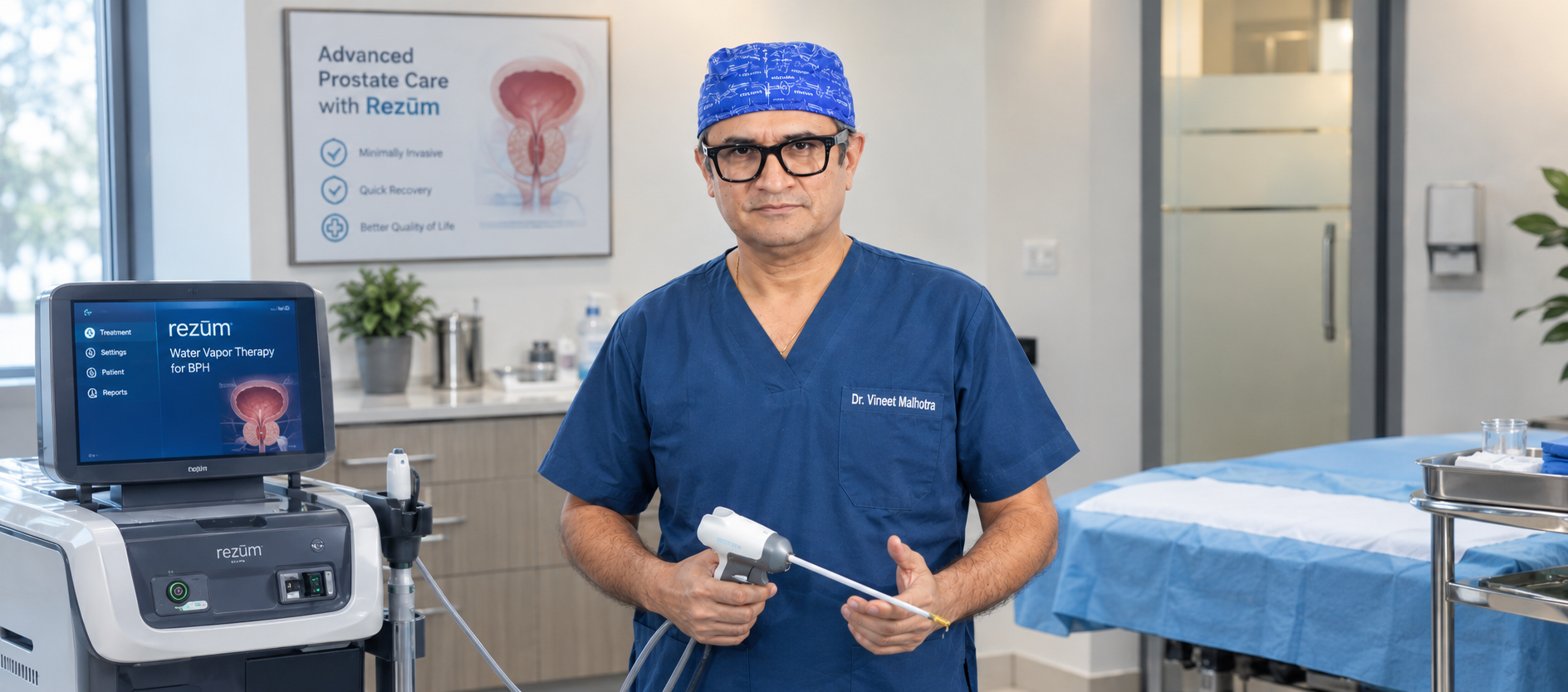
Rezum is a minimally invasive BPH treatment that delivers controlled water vapour into selected areas of prostate tissue. The treated tissue gradually reduces through the body's natural healing process. Improvement is not necessarily immediate, and temporary urinary symptoms or catheter use may occur.
What is UroLift treatment for the prostate?
UroLift is a prostatic urethral lift procedure. Small implants are used to hold selected prostate tissue away from the urethra, widening the urinary passage. Suitability depends on prostate size and anatomy.
What is iTind treatment?
iTind uses a temporary implantable nitinol device placed through the urethra. It applies controlled pressure at selected points to remodel the prostatic urethra. The device is removed after the planned treatment period. It is not appropriate for every patient.
Are Rezum, UroLift and iTind minimally invasive treatments?
Yes. These are minimally invasive approaches that work differently from tissue-removing operations such as TURP and HoLEP. Their suitability depends on patient selection, prostate anatomy, device indications and availability.
Will prostate treatment affect sexual function?
Sexual and ejaculation-related effects differ between procedures and between individuals. Some treatments can cause changes in ejaculation, while other sexual effects may depend on the patient's existing health and condition. Discuss your priorities and concerns with your urologist before choosing a procedure.
Does every enlarged prostate require surgery?
No. Many men can initially be managed with monitoring, lifestyle adjustments or medication. A procedure may be considered when symptoms remain troublesome despite treatment, complications develop, or clinical findings indicate that an intervention is appropriate.
How is prostate size measured?
Prostate size is commonly assessed using ultrasound. The urologist may also consider prostate shape, urinary flow, post-void residual urine and other findings when selecting a treatment.
How long does recovery take after prostate surgery?
Recovery varies according to the procedure, the patient's health and the nature of the condition. TURP and HoLEP generally involve a different recovery process from minimally invasive treatments such as Rezum, UroLift and iTind. Your treating team will provide procedure-specific instructions.
Can an enlarged prostate cause urinary retention?
Yes. Significant obstruction can sometimes cause urinary retention, meaning the bladder cannot empty adequately. Sudden inability to pass urine is a medical emergency and requires urgent medical attention.
Can I consult Dr. Vineet Malhotra for prostate treatment in Delhi?
You can request an appointment with Dr. Vineet Malhotra at VNA Hospital, New Delhi, for evaluation of prostate enlargement and urinary symptoms. The consultation helps determine which investigations and treatment options may be appropriate.

Take the Next Step

Looking for Prostate Treatment in New Delhi?

Do not let persistent urinary symptoms affect your sleep and everyday life. Arrange a consultation to discuss your prostate health, understand your diagnosis and explore suitable treatment options.

Consultation Location

VNA Hospital

1, Navjeevan Vihar, Geetanjali Enclave, Malviya Nagar, New Delhi, Delhi – 110017

Medical Disclaimer: This page is for general educational purposes and does not replace an individual consultation, examination or medical advice. Not every procedure is suitable for every patient. Treatment decisions depend on clinical assessment, prostate anatomy, medical history, applicable device indications and availability. All procedures carry potential risks and limitations. Please consult a qualified urologist for personalised advice.